The Coat of Arms of the Château de l’Hermitage
The lion of Saint-Mesmin, the lilies of the Vendée and the two hearts of the Sacred Heart: a shield that tells of the place and its spirit.
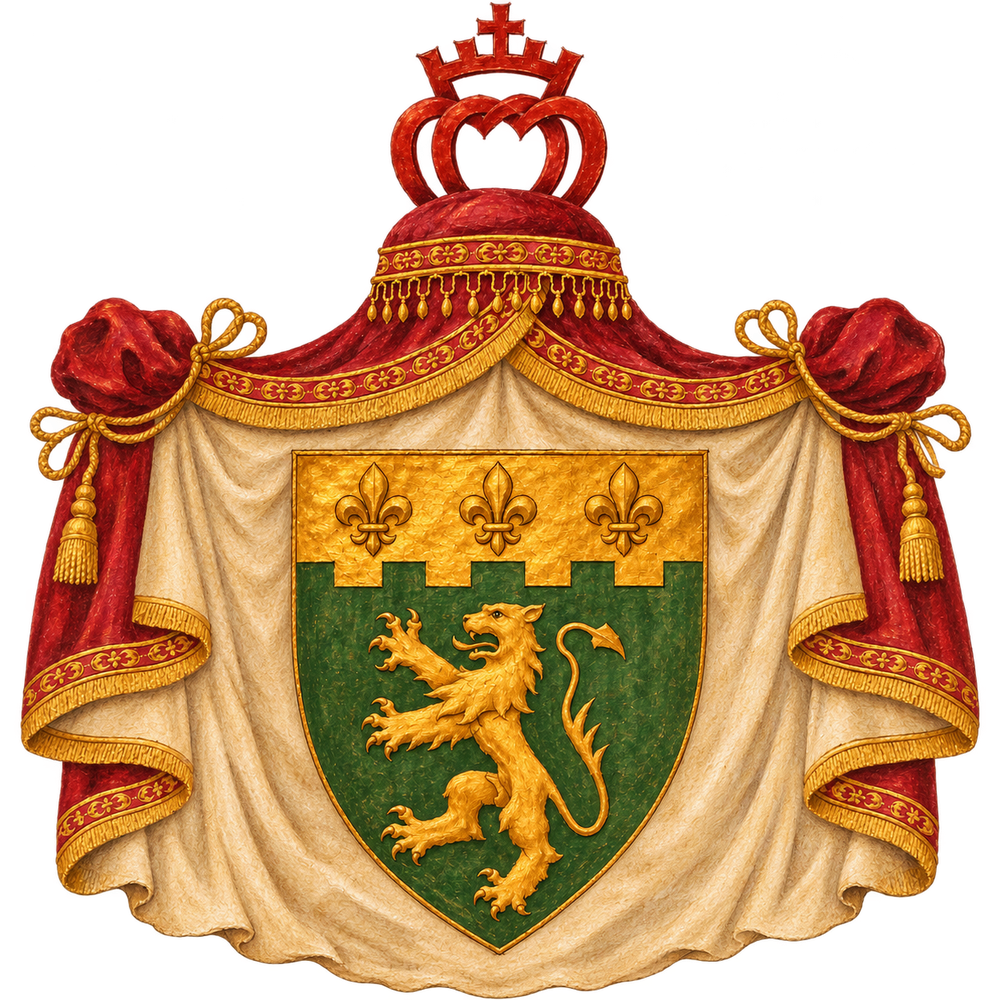
The arms of l’Hermitage did not come from nowhere. They borrow their green field, their golden lion and their embattled chief from the arms of the village of Saint-Mesmin, then charge the chief with three fleurs-de-lis: a manor of the village placing itself under the colors of its parish and under the sign of the Vendée of 1793.
Arms born from those of Saint-Mesmin
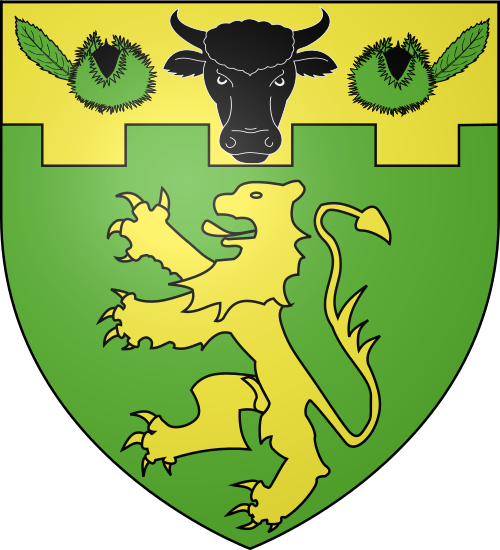
The village of Saint-Mesmin bears:
Vert, a lion or; on a chief embattled or, an ox’s head caboshed sable between two chestnuts proper in their husks vert, leaved vert.
The golden lion on a green field comes from the Montfaulcon family, former lords of the place, whose arms were vert, a lion or. The embattled chief recalls the castle of Saint-Mesmin, its tower and walls; the ox’s head and the chestnuts speak of the bocage, its farms and its sunken lanes.
The shield of l’Hermitage keeps everything that makes up the identity of the village: the green field, the golden lion and the golden embattled chief. It changes only one thing, in the manner of the “differences” of old heraldry: in place of the ox’s head and chestnuts, the chief bears three fleurs-de-lis. The house thus shows itself a daughter of Saint-Mesmin, while saying what is its own.
The golden lion
In heraldry, the lion stands for strength, courage and fidelity. At Saint-Mesmin, it is first of all the memory of the lords who held the land and defended the castle. On the shield of l’Hermitage, it recalls that the house belongs to this village of the High Bocage and to its history.
The three lilies: the spirit of the Vendée and the hope of the king
The three fleurs-de-lis are the arms of the Kings of France. In the Vendée, they took on a particular meaning: in 1793, the peasants of the bocage rose “for God and for the King” under the white, lily-strewn flag of the Catholic and Royal Army. The three lilies of l’Hermitage carry this memory: the fidelity of a land that suffered so much for its faith, and the spirit of the Vendée, attached to its bell towers, its families and its freedom.
They also express a hope, that of the return of the Catholic king. Catholic popular tradition long spoke of a “Great Monarch,” a most Christian king who would one day raise France up again; this prophecy, widespread in the Middle Ages and much read in the nineteenth century, fed the imagination of royalist western France. We cite it here as a cultural reference, not as a belief: it belongs to the heritage of the Vendée, just as its songs, its wayside crosses and its legends do. It is also the theme of the house, the Return of the King, which runs through the décor of the manor and through our Tales and Legends of Catholic Vendée.
The two Vendéan hearts
Above the shield, two interlaced hearts are surmounted by a crown and a cross. This is the Sacred Heart that the Vendéan fighters sewed on their breasts, which became the emblem of the Vendée and is still borne by the Department today. It places the arms under the sign of the faith of the bocage.
The mantle
The red mantle, lined, fringed and tied back with gold, is an external ornament chosen for the beauty of the composition. It frames the shield in the manner of great armorial bearings of old, without claiming any title.
Manor or château?
L’Hermitage is a family house, a manor on the scale of one family, with its park of four hectares. Yet it is often called the “Château de l’Hermitage,” as the bocage readily gives that name to any gentleman’s house set in a park. The word appears notably in material about the stay of Georges Simenon in Saint-Mesmin, from December 1942 to September 1944, when the writer came there to play cards: the leaflet of the Georges Simenon Walk, published by the village, makes it the eighth stop of the trail under the name “Château de l’Hermitage.” A manor by its size, a château by usage: both names are right, and this site uses both.
Arms of Saint-Mesmin: Wikimedia Commons. Blazon of the village after the armorial of the communes of the Vendée.
Stay under the arms of l’Hermitage
A family manor in the heart of the bocage, twenty minutes from the Puy du Fou, where the story of the returning king is still told.

