
Georges Simenon
The creator of Inspector Maigret, and his war years in the Vendée.
Georges Simenon (1903 to 1989), the Belgian novelist who created Inspector Maigret, is one of the most widely read French-language writers of the twentieth century. For five years, from 1940 to 1945, he lived in the Vendée, and those years inspired some fifteen of his novels.
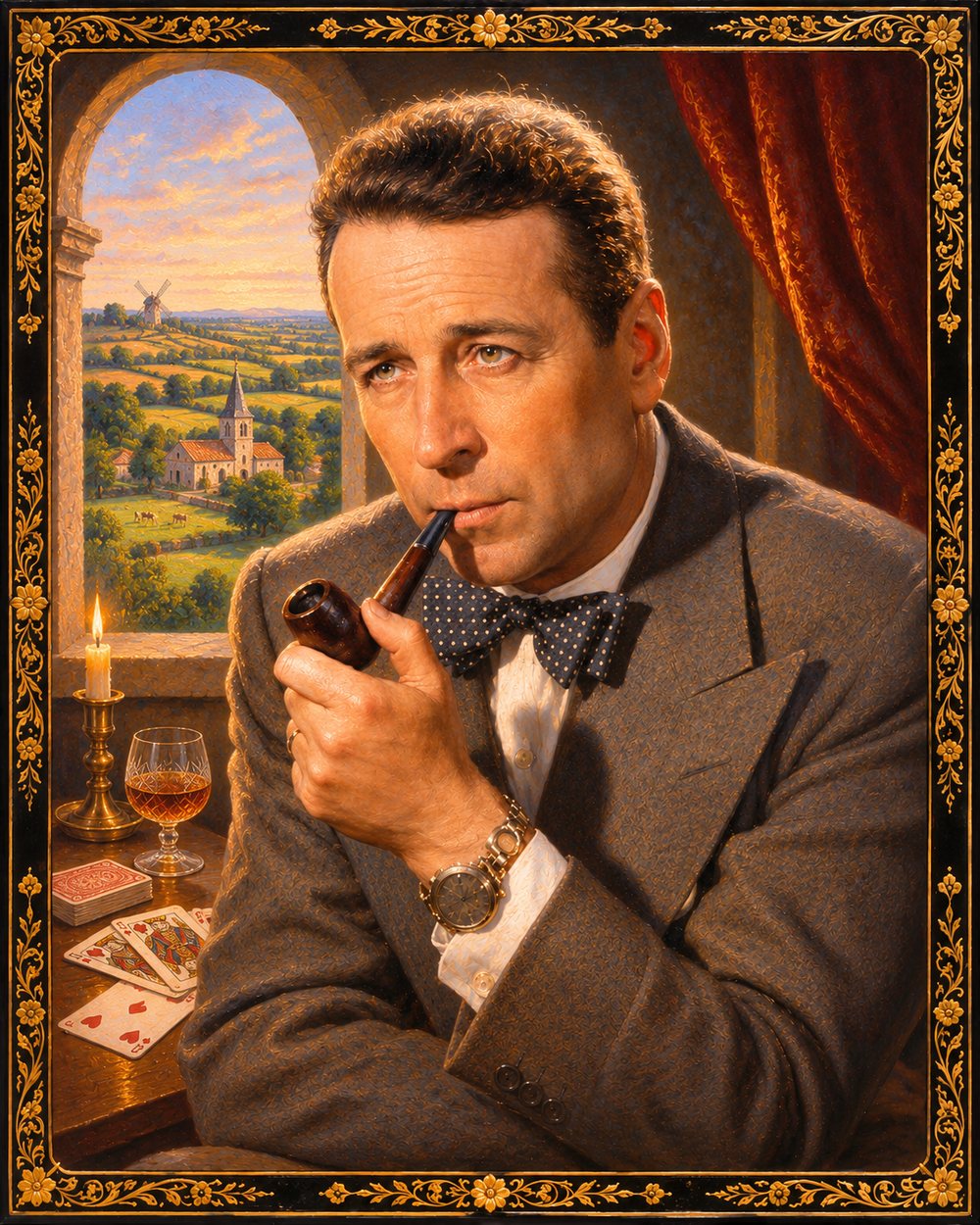
The war years in the Vendée
When war came, Simenon left the Charente-Maritime coast for the Vendée. He settled first in Fontenay-le-Comte, then spent time by the sea, and from December 1942 to September 1944 he lived with his wife Tigy and their young son Marc to a rented villa on the avenue des Monts in Saint-Mesmin, then often called Saint-Mesmin-le-Vieux.
It was in Saint-Mesmin that Simenon wrote L’Inspecteur Cadavre (Inspector Cadaver), a Maigret novel set in the damp, closed world of a small village in the Vendée marshes. Years later, he dedicated another novel, Le Cercle des Mahé (The Mahé Circle), to Tigy in remembrance of Saint-Mesmin.
Simenon at l’Hermitage
During those years, Simenon often came to the Manoir de l’Hermitage to play cards. The manor is today one of the stops on the Georges Simenon Walk, the trail that follows his steps through Saint-Mesmin, and its panel hangs on the wall of the house.
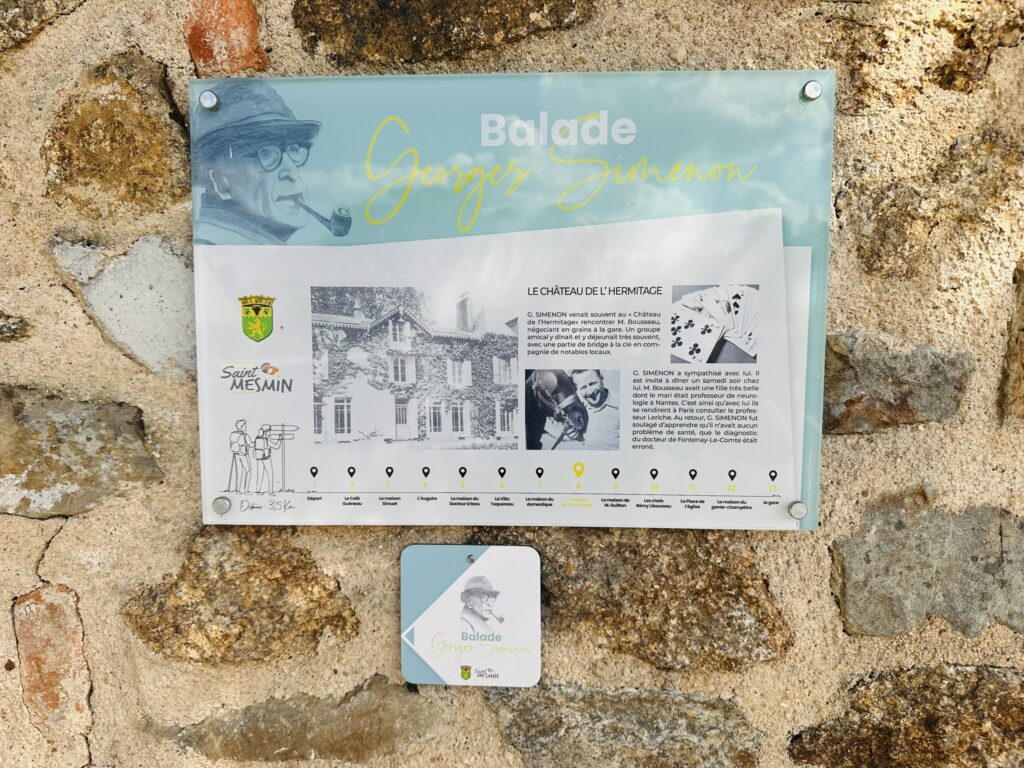
The Georges Simenon Walk
The village of Saint-Mesmin has laid out a 3.5 km trail, “Sur les pas de Georges Simenon” (In the footsteps of Georges Simenon), which starts from the church square and has thirteen stops marked by panels. The walk’s leaflet recalls that the writer lived in Saint-Mesmin from December 1942 to September 1944, for the quiet of the village during the Occupation. L’Hermitage is its eighth stop, under the name “Château de l’Hermitage.”
- Start
- The Café Guéneau
- The Sirouet house
- L’Augoire
- Doctor Erieau’s house
- The Villa Toquereau
- The servant’s house
- The Château de l’Hermitage
- M. Guitton’s house
- The Rémy Liboureau wine stores
- The church square
- The village constable’s house
- The railway station
The texts of the panels draw on the books of Simenon and his biographers, on personal papers and on photographs from the town hall, gathered by a group of residents and local councillors.
The walk’s leaflet (PDF, in French) Pays de Pouzauges tourist office
After the war
Simenon’s conduct during the Occupation remains a subject of debate among historians. He was held under administrative detention in Les Sables-d’Olonne from the summer of 1944, and in 1945 he left France for North America, where he lived for the next ten years.
Simenon and the Vendée today
The Vendée has not forgotten him. In 2011 and 2012, the Historial de la Vendée devoted a major exhibition to “Georges Simenon, from the Vendée to the four corners of the world.” For readers, the countryside around Saint-Mesmin, with its hedgerows, its rain and its closed villages, is still recognizably the country of his Vendée novels.
Coming to l’Hermitage
For a stay, a seminar, a wedding, horse boarding or a viewing with a view to purchase, write to us with your dates and the number of people.

